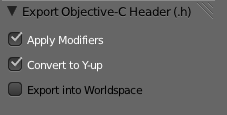
Thanks to some help from some readers, I've got a new and improved version of the
Blender Export Script for Objective-C. This new version works correctly regardless of whether there's a texture. If you've used vertex paint, it will export the vertex colors. If you have neither vertex colors or a mapped texture, then it will just export the vertices and normals. It will also update the drawing code as appropriate to the data that's been exported.
Also, new with this version, you don't need to triangulate the faces, nor do you need to apply modifiers. Those will happen automatically in the export without affecting your original model. That should make it easier to update and maintain the models you use in your iPhone apps.
You can download the new script from the link above. I'm including the script here for the curious:
Note of warning: I have not tested this script very thoroughly, so caveat emptor! Fixes and improvement suggestions welcome, as always.
"""
Name: 'Objective-C Header (.h)'
Blender: 244
Group: 'Export'
Tooltip: 'Exports header file for use with the OpenGL ES template for iPhone available from http://iphonedevelopment.blogspot.com/'
"""
import Blender
from Blender import *
import bpy
import bpy
import os
def write_obj(filepath):
out = file(filepath, 'w')
sce = bpy.data.scenes.active
ob = sce.objects.active
mesh = Mesh.New()
mesh.getFromObject(ob.name)
editmode = Window.EditMode()
if editmode: Window.EditMode(0)
has_quads = False
for f in mesh.faces:
if len(f) == 4:
has_quads = True
break
if has_quads:
oldmode = Mesh.Mode()
Mesh.Mode(Mesh.SelectModes['FACE'])
mesh.sel = True
tempob = sce.objects.new(mesh)
mesh.quadToTriangle(0) oldmode = Mesh.Mode(oldmode)
sce.objects.unlink(tempob)
Mesh.Mode(oldmode)
objectname = ob.getData(True)
basename = objectname.capitalize()
out.write('#import "OpenGLCommon.h"\n\n\n')
if (mesh.faceUV):
out.write('static const TexturedVertexData3D %sVertexData[] = {\n' % basename)
for face in mesh.faces:
for (vert, uvert) in zip(face.verts, face.uv):
out.write('\t{/*v:*/{%f, %f, %f}, ' % (vert.co.x, vert.co.y, vert.co.z) )
out.write('/*n:*/{%f, %f, %f}, ' % (vert.no.x, vert.no.y, vert.no.z))
out.write('/*t:*/{%f, %f}' % ( uvert.x, uvert.y ) )
out.write('},\n')
out.write('};\n\n')
elif (mesh.vertexColors):
out.write('static const ColoredVertexData3D %sVertexData[] = {\n' % basename)
for face in mesh.faces:
for (vert, color) in zip(face.verts, face.col):
out.write('\t{/*v:*/{%f, %f, %f}, ' % (vert.co.x, vert.co.y, vert.co.z) )
out.write('/*n:*/{%f, %f, %f}, ' % (vert.no.x, vert.no.y, vert.no.z))
out.write('/*c:*/{%f, %f, %f, %f}' % ( color.r / 255.0, color.g / 255.0, color.b / 255.0, color.a / 255.0) )
out.write('},\n')
out.write('};\n\n')
else:
out.write
out.write('static const VertexData3D %sVertexData[] = {\n' % basename)
for face in mesh.faces:
for vert in face.verts:
out.write('\t{/*v:*/{%f, %f, %f}, ' % (vert.co.x, vert.co.y, vert.co.z) )
out.write('/*n:*/{%f, %f, %f} ' % (vert.no.x, vert.no.y, vert.no.z))
out.write('},\n')
out.write('};\n\n')
if editmode: Window.EditMode(1)
out.write('#define k%sNumberOfVertices\t%i\n' % (basename, len(mesh.faces) * 3) )
out.write('// Drawing Code:\n')
out.write('// glEnableClientState(GL_VERTEX_ARRAY);\n')
if (mesh.faceUV):
out.write('// glEnableClientState(GL_TEXTURE_COORD_ARRAY);\n')
elif (mesh.vertexColors):
out.write('// glEnableClientState(GL_COLOR_ARRAY);\n')
out.write('// glEnable(GL_COLOR_MATERIAL)\n')
out.write('// glEnableClientState(GL_NORMAL_ARRAY);\n')
out.write('// glVertexPointer(3, GL_FLOAT, sizeof(TexturedVertexData3D), &%sVertexData[0].vertex);\n' % basename)
out.write('// glNormalPointer(GL_FLOAT, sizeof(TexturedVertexData3D), &%sVertexData[0].normal);\n' % basename)
if (mesh.faceUV):
out.write('// glTexCoordPointer(2, GL_FLOAT, sizeof(TexturedVertexData3D), &%sVertexData[0].texCoord);\n' % basename)
elif (mesh.vertexColors):
out.write('// glColorPointer(4, GL_FLOAT, sizeof(ColoredVertexData3D), &%sVertexData[0].color);\n' % basename)
out.write('// glDrawArrays(GL_TRIANGLES, 0, k%sNumberOfVertices);\n' % basename)
out.write('// glDisableClientState(GL_VERTEX_ARRAY);\n')
if (mesh.faceUV):
out.write('// glDisableClientState(GL_TEXTURE_COORD_ARRAY);\n')
elif (mesh.vertexColors):
out.write('// glDisableClientState(GL_NORMAL_ARRAY);\n')
out.write('// glDisable(GL_COLOR_MATERIAL);\n')
out.write('// glDisableClientState(GL_NORMAL_ARRAY);\n\n\n')
out.close()
filename = os.path.splitext(Blender.Get('filename'))[0]
Blender.Window.FileSelector(write_obj, "Export", '%s.h' % filename)
Thanks to Scott Lyons and Dennis Ippel for their Python and Blender API smarts. I couldn't have gotten this far without their help.